
How to Unlock Higher Essay Grades with Bloom’s Taxonomy

In this episode, I delve into the transformative power of Bloom's Taxonomy for essay writing.
You'll discover how this powerful framework, developed by educational psychologist Benjamin Bloom, can help you deepen your understanding, better interpret essay questions, allocate your word count effectively, and self-assess your writing skills.
I'll guide you through the six levels of Bloom’s Taxonomy, showing you how to harness each one to enhance your essays and achieve higher grades.
Whether you're balancing study with work or family commitments, this episode offers practical strategies to boost your confidence and elevate your academic performance.
Tune in to unlock the secrets to writing better essays with Bloom's Taxonomy!
This post originated as a podcast episode which you can listen to below or search for episode 161 of the Chloe Made Me Study podcast. Or, if you’re more of a learn-by-reading student, carry on for the rough-and-ready blog version based on the podcast script.
Welcome to episode FIVE of this six-part series all about how to write better essays. Episode 157, shared the 5 simple, essential requirements of every first class essay. Episode 158 shared how to use the PEEL method to write powerful paragraphs. And last week, episode 159 was all about my simple technique to stop the tangents so you can actually answer your essay question (and achieve high marks). And episode 160 was about overcoming the big barrier that’s stopping you from achieving higher grades. So be sure to check these out if you haven’t yet.
This week, I’m going to be sharing with you another awesome tool that’s going to unlock easier, better essay writing for you: Bloom’s Taxonomy created by Benjamin Bloom. And I’m going to share with you four ways you can use it to significantly improve your essay writing skills and help you achieve higher grades.
What is Bloom’s Taxonomy?
So, who is Benjamin Bloom, and what is his taxonomy? Benjamin Bloom was an educational psychologist who developed a model in the 1950s which is often referred to as Bloom’s Taxonomy. This model classifies learning goals into six levels of complexity. Imagine a pyramid split into six horizontal layers. The lowest level, the base of the pyramid, represents the least complex level of thinking, with the most complex level being the layer right at the tip of the pyramid.
Bloom’s Taxonomy can be used in lots of different ways, and can be used by teachers to design structured learning. But as students, we can also use it to deepen our understanding and ensure that we’re ticking all the right boxes with our written work to get the highest marks.
The six levels of Bloom’s Taxonomy
OK, so there are six levels to Bloom’s Taxonomy. From the bottom up we have Remembering, then Understanding, then Applying, then Analysing, then Evaluating and then finally, right at the top, we have Creating. From bottom to top, these levels represent lower to higher order thinking skills – meaning they take more brain power and skill to do. Let me walk you through an example using the concept of attachment theory from psychology (and no, you don’t need to understand what it is to grasp this).
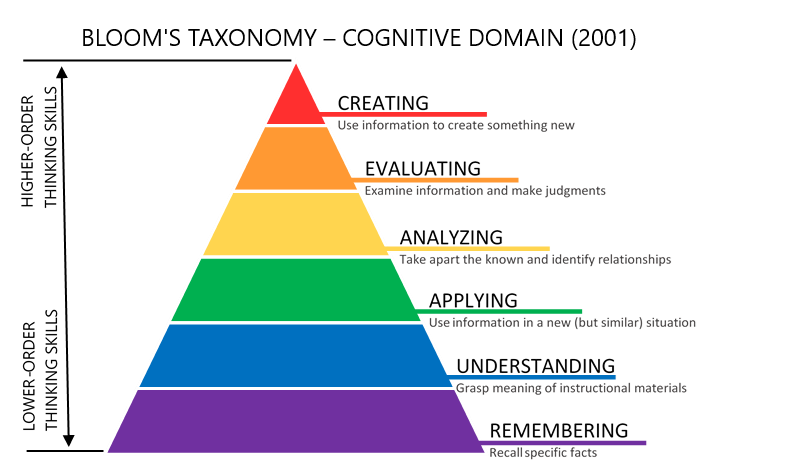
Remembering: At this level, you can simply recall the name of the theory and its author. For example, you remember that John Bowlby developed attachment theory.
Understanding: Next, you can explain the concept of attachment theory in simple terms. You might describe how it suggests that the bond between a child and their caregiver is crucial for emotional development.
Applying: Here, you can describe how attachment theory can be applied to a real-life situation. For instance, you might explain how a teacher can use the principles of attachment theory to support students with separation anxiety.
Analysing: At this level, you can break down the components of attachment theory. You could analyse the different attachment styles and how they influence behaviour and maybe even compare it to other theories.
Evaluating: Now, you can critically assess the strengths and weaknesses of attachment theory. You might evaluate the evidence supporting the theory and consider alternative explanations.
Creating: Finally, you can propose a new approach or modification to attachment theory based on existing knowledge. This could involve synthesising ideas from multiple theories to create a new model for understanding child development.
Now this example demonstrates the different levels and depths of learning that can be achieved with just one concept. This is not a prescription for how to write an essay about attachment theory. Because you need to follow the lead from your essay – use the question and guidance to work out which levels you need to tick off and demonstrate in your work. I’ll cover how to do this a little later.
Four ways to use Bloom’s Taxonomy to improve your essay grades
Now, let’s talk about four ways you can use Bloom’s Taxonomy to improve your essay skills and achieve higher marks.
#1 Bloom’s Taxonomy is a framework for deepening your understanding
First, Bloom’s Taxonomy provides a framework for deepening your understanding. The six levels allow you to identify where your current knowledge stands. Without this framework, it’s easy to overestimate your understanding. You might be able to define an idea and explain its core details in an essay. But are you able to confidently apply the theory to a situation, analyse all its component parts, evaluate its strengths, weaknesses and usefulness in different contexts, or even create a new idea by synthesising it with other ideas? Therefore, Bloom’s Taxonomy is a way you can prove your knowledge or knowledge gaps which means you can then use it as a goal setting tool to deepen your understanding so you can nab higher grades.
#2 Bloom’s Taxonomy will help you better understand your essay questions
As I mentioned earlier, you might not need to demonstrate all six levels of skills in your essays, or in a particular essay. These are levels of learning for a reason. When you’re in the early stages of a qualification or module, it is likely that you will be set assignments that test the lower few levels of skills. Then, as you progress, your essays will get harder in that they will expect you to demonstrate higher order thinking skills such as application, analysis, evaluation and creation.
This isn’t a guessing game, and you 100% should not wing this. Instead, use Bloom’s Taxonomy to gain a clearer understanding of your essay questions. Read through your essay question and all the accompanying guidance to identify all the verbs – the words that tell you what to DO in your essay. These verbs will help you identify the levels of Bloom’s Taxonomy you need to include, specifically what the highest level of skill that is required.
Now, your essay questions and guidance might not hand this to you on a plate. They might use different words and phrases so you need to get smart and work out which level they’re talking about. Here are some examples:
"List" and "define" and “identify” are about REMEMBERING.
"Explain" and "describe" and “summarise” are about UNDERSTANDING.
"Illustrate" and "demonstrate" and “use” are about APPLYING.
“Examine” and "compare" and "contrast" are about ANALYSING.
"Discuss" and "critique" and “assess” are about EVALUATING.
"Design" and "develop" and “propose” are about CREATING.
Understanding these verbs will help you identify which higher-order skills are needed for your essay, which will ensure you focus on developing the right skills and including the right points to achieve a high grade.
#3 Bloom’s Taxonomy will help you focus your word count effectively
Bloom’s Taxonomy will help you to better focus the word count of your essay. A common struggle for students is knowing where to spend their words. How much description is needed? How much analysis? By understanding the highest level of skill required in your essay, you can allocate your words more effectively.
For example, if your question asks for critical analysis and evaluation, you don’t want to spend the majority of your word count describing key ideas. Instead, focus on providing in-depth analysis and evaluation. This is where I see a lot of students trip up. They get stuck in description land rather than getting to the meaty stuff. If you have been tasked with hitting levels 4 and 5 of Bloom’s Taxonomy – analysing and evaluating – then a significant amount of your word count needs to be spent doing those things if you want to tick the boxes and get good marks.
In last week’s episode, episode #160, we talked about identifying the skills you need to improve and then taking action to improve them so your marks can climb in your next essay. So if you know that you’re getting stuck in description land in your writing, your job now is to improve your critical thinking and writing skills so you can climb that pyramid and nab the higher marks.
#4 Bloom’s Taxonomy will help you self-assess your writing skills
Bloom’s Taxonomy is a great tool for self-assessment. After receiving your essay mark and feedback, use Bloom’s framework to decipher what you did well and what you need to improve. Here are some examples.
If you get feedback correcting some of your points, or stating that you’ve missed out something key, then this demonstrates an issue at level 2 on the pyramid – understanding. So your focus moving forward would be to work on your close reading and knowledge of the course material.
Whereas feedback that states “good understanding of relevant theory” indicates that you’re nailing level 2 of the pyramid. For an essay where the question only requires level 1 and 2 skills (remembering and understanding), this is great. But if the essay actually required higher-order skills like analysis or evaluation, you’ll know that this is where you need to focus next time.
Feedback such as “more analysis needed” points directly to an issue with level 4 – analysing.
Or feedback that states, “missing inclusion of limitations of the theory” implies that you need to work on your analysing and evaluating skills.
By understanding these levels, you’ll be able to map your feedback to specific skills that you need to improve so you can more accurately target your efforts to improve future essays.
Summary
So there we have it, Bloom’s Taxonomy is a simple but pretty powerful tool for improving your essay writing skills. It provides a structured framework to deepen your learning, can help you understand your essay questions better, allows you to focus your word count effectively, and is a valuable tool for self-assessment. By applying these strategies you will become a better writer who can submit the RIGHT essays that tick all the boxes to achieve higher grades.